I Bind Unto Myself
A sermon for Trinity Sunday (Year A)

One summer when I came home from college I went to church like normal, and our priest, The Rev. Fran McCoy, of blessed memory, at Coffee Hour said she was going out of town and asked if I would lead Morning Prayer and preach the next Sunday. This wasn’t exactly anything new, I’d been preaching on and off since I was 13. So I said, sure, I’d be glad to do it. “Great!” Fran+ said, “It’s Trinity Sunday, so good luck!”
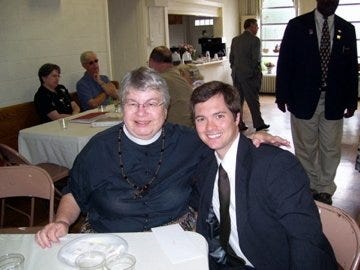
Can you believe she asked that kid to preach?!
I didn’t know anything about Trinity Sunday. I didn’t know that it was something of an inside joke for priests to leave town and ask a deacon, a seminarian, or some other sucker to preach on Trinity Sunday. I didn’t know how to try and encapsulate the defining doctrine of Christianity in a sermon that would or should be – God help us – less than 20 minutes. I don’t have a copy of that sermon, but I do remember the basic gist of it. Even in my early 20s I somehow could understand that the Trinity is how God is expressed and experienced in our lives: God the Father is the comforting parent, Jesus the Son is a friend and companion on the journey, and the Holy Spirit is God’s voice still speaking to guide us on our way; that was, more or less, what I said. My seminary professors and classmates would’ve probably poked a bunch of holes in that sermon, but the church didn’t spontaneously burst into flames when I preached it, so that was a win.
I went on to do all the studying and read all the things. I studied extensively the ecumenical councils at Nicea and Constantinople (not Instanbul). I read John Zizioulas’ Being as Communion and its thesis that personhood is the ground on which all theology is based and ultimately how God operates as the Trinity. I heard my church history professor tell the tall tale of St. Augustine of Hippo, who saw saw a child building a sand castle and filling in the holes, and Augustine told the child, “Don’t you know it’s impossible to fill sandholes with water?” to which the child replied, “No more impossible for me, than for you to write a treatise on the Trinity!” I got all the book-learnin’ and listened to the scholars and important people. I have preached and talked about this feast plenty of times since that day at All Saints in Norton, VA, but I wonder if anything more can really be said.
How do we even talk about the Trinity, really? How do we make sense of something that appears in the Scriptures precisely once – Matthew 28: 19 is the only time that “Father, Son, and Holy Spirit” in that order, show up in the Bible. It is a doctrine, meaning that is decisive, a critical common denominator amongst every Christian church, but it’s also a sacred mystery that we experience and celebrate, while maybe never being able to express it completely with words; it’s a mystery that in the end is not intended to be demonstrable on strictly rational terms. But there are a few things we can say about it, and much that it tells us about God.
Theologically, the Trinity shows us a great deal. For starters, it gives us a sort of map or blueprint for who our God is. Ours is the God who created all things, whose very breath moved at the beginning of the creation; in fact, the Hebrew verb translated as “created” comes from the same Hebrew word for womb. God, it can be said, wombed the heavens and the earth. The Trinity shows that ours is a God who is actually interested in the human experience, not as a plaything like the pantheon of old gods, but in the ongoing work of redemption, through covenant relationships established by Abraham and Sarah and renewed in the self-sacrificing love of Jesus, the very conduit through which we know this redemption. And ours is a God who excites and energizes humanity, whose Spirit is shown through gifts like patience, gentleness, and self-control, to borrow some of St. Paul’s words.
The Trinity also makes clear to us how God plays all the roles in the drama of salvation. Shakespeare said that all the world is a stage in As You Like It, and God is the top-billed star in this great drama that is unfolding, for which we are both the audience and the co-stars. The Greek theologian Tertulian was the first to refer to God as being “one God in three Persons (or personas).” In ancient Greek theatre a persona was a mask a single actor would use to play multiple roles, changing their persona as necessary. In this great drama of life, the Trinity shows us how the creation, the redemption, and the sanctification of all things are played out by one single actor – God – in these three distinct personas that we call Father, Son, and Holy Spirit.
We could talk all day about what the Trinity is doing form a theological standpoint. And yet, I cannot help but think more often about what the Trinity is doing from a relational standpoint. One of the best depictions I’ve seen of the Trinity is in William Paul Young’s book The Shack, a story written by someone with no theological education, as a gift to his family, an attempt to articulate what his experience of God was in the wake of a horrible tragedy, and it works, especially in a scene where Jesus – depicted as a Palestinian carpenter – and the Holy Spirit – a young Asian woman – are playfully dancing together. God the Father – shown as a Black woman – says to the book’s author, who is spending a weekend in a shack with the Trinity, that this image of the Son and Spirit was the dream for humanity, that we might dance together the way the Trinity does. At its core, that’s what the Trinity is, it’s relational. The Trinity offers us a loving relationship model instead of fractured arguments, a delightful and powerful intimacy, a relationship of love among the three Persons that serves as a model for our own lives, as we seek to live together in harmony, respecting the individual while never rejecting the unity.
It is that relational component that I always come back to, that I always lean on. Because when I consider the Trinity, I’m taken back to All Saints in Norton, but not to that sermon, to a moment in time I don’t even remember: Trinity Sunday, 1984, the day my mother, my sister, and I were all baptized together. It is still to this day, the only triple baptism in that little church’s history. My mother is somewhere on a far greater shore now, I imagine drawing pictures in the sand. My sister is not a churchgoer for plenty of understandable reasons. Yet the Trinity binds us together, binds us to that blessed day 42 years ago, binds us in the holy dance of love, grace, and mercy that neither distance nor death can separate.
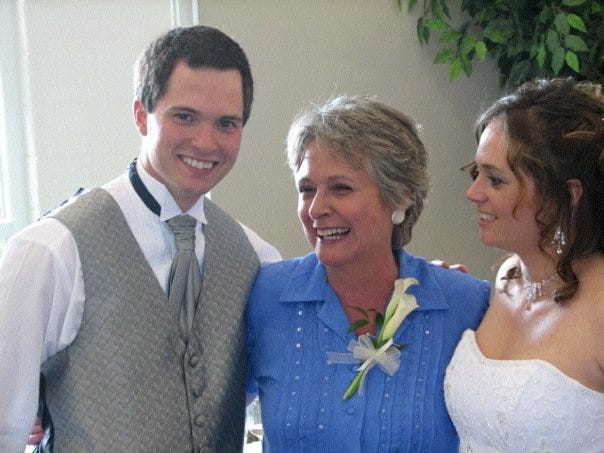
My mother, sister, and I in 2007
When Jesus tells his disciples to go and baptize in the name of the Father, Son, and Holy Spirit, this is what I think he means. Because the Trinity connects us to each other, connects us to God’s unfolding drama in the world, and connects us to holy mystery. The mystery of creation, of redemption, of salvation, of love and life itself.
Yes, our churches on Sunday sang that ancient hymn of St. Patrick to bind unto ourselves the strong name of the Trinity. Yes, we affirmed our faith in the Trinity that our ancestors laid down for us at those councils. But let us also make room to rest in the mystery and to know a couple of important truths. Know that you are loved with this sacred and eternal love that stretches back to the moments breath and light came into the world. Know that the Trinity gives you permission to not know, to not be certain, of anything except your place in this holy dance, this unfolding drama that God is out working in and through you.
I wonder what comes to your mind when you think of the Trinity. Does it take you back to a place and time, or to people, as it does for me? To a particular church? The place you were baptized? The people who have loved and supported you? Old friends long gone? Maybe one day, it will take you back to this very moment. Let the strong name of the Trinity bind you to our relational God, to your own community, and to the whole Body of the faithful from generation to generation. In the name of the Father, Son, and Holy Spirit. Amen.